Mary Katharine Goddard's name may not be immediately recognizable, but she was a pivotal figure in the story of American independence. In January 1777, this Baltimore printer (and first female postmaster in the US) produced the first official copy of the Declaration of Independence to list all 55 signers by name. Previous printings had left the names off to protect the signers from British retaliation. Goddard's version was the first to reveal them publicly, and she proudly included her own name at the foot of the sheet, the only woman to appear on the document.
Nearly 250 years later, a new public artwork brings her story back into view. Becky Ault and Mike Cunningham of ART Design Group created the monument for Veterans Memorial Park in Lakeland, Florida, with Platform Art leading the project in collaboration with the Lakeland Chapter of the Daughters of the American Revolution and the Polk County Veterans Council, as part of the America 250 Path to Freedom initiative.
“This is more than a monument; it's a statement about who we are as a community and nation,” said Cynthia Haffey, Director of Platform Art. “Mary Katharine Goddard's story deserves a place in Lakeland. During America's 250th anniversary year, we're honoring all patriots while contributing something meaningful and enduring to the public realm.”
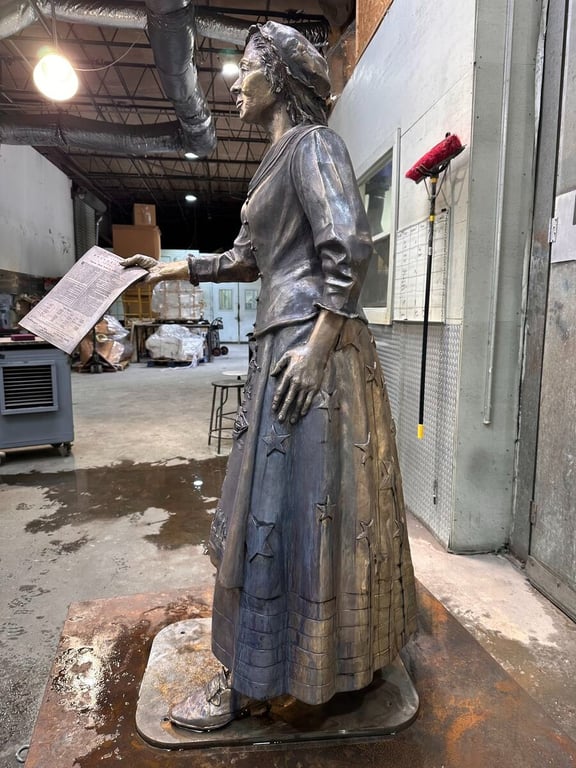
The finished bronze monument of Mary Katharine Goddard, holding the printed Declaration.
Expanding the Monument
Monuments can tell us who a culture chooses to remember, and their scale and permanence in shared civic space give histories a lasting public presence. What stories monuments choose to convey has become an increasingly important question in contemporary communities. Public art can widen that circle, bringing forward figures whose contributions haven't always gotten the spotlight they deserve.
That was the starting point for this commission. The Lakeland DAR and Polk County Veterans Council came to Platform Art seeking a monument to the American Revolution built around people who supported it but rarely get named, and Goddard was a natural fit. She printed and published, served as Baltimore's postmaster, and later ran a bookselling and stationery business, and led a life that traces the labor and conviction behind how political ideas reached the public.
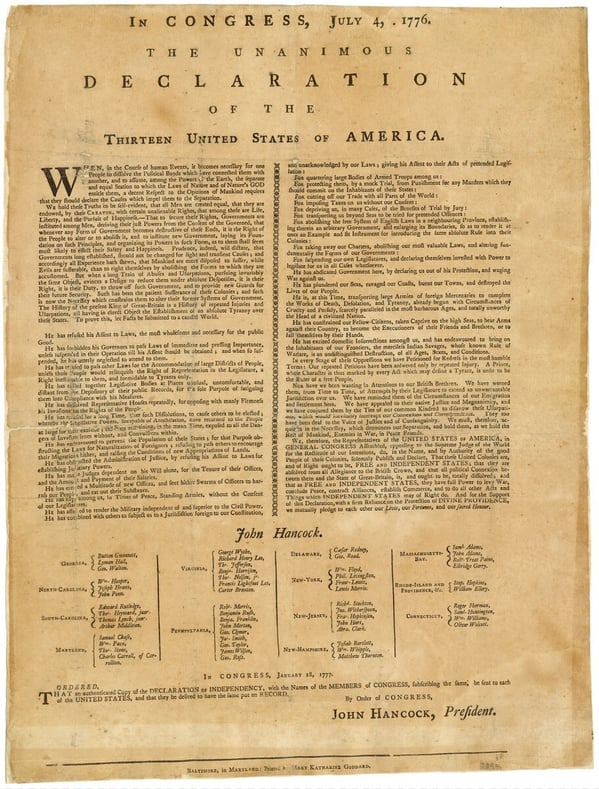
The Goddard broadside of the Declaration of Independence, printed in Baltimore in January 1777, with her name at the bottom: “Baltimore, in Maryland: Printed by Mary Katharine Goddard.”
Translating History into Form
ART Design Group translated this history into a larger-than-life figurative sculpture. Goddard stands holding the printed Declaration in one hand, the document that made her name public. Stars are worked into the surface of her skirt, along with raised imagery lower on the panel, adding further historical detail to the form.
The sculpture grew out of deep research, both into Goddard's life and her role in this pivotal moment in the country's history, done in partnership with historians and museums to verify the details. From there, the artists developed concept renderings, then a small working model to guide the full-scale figure.
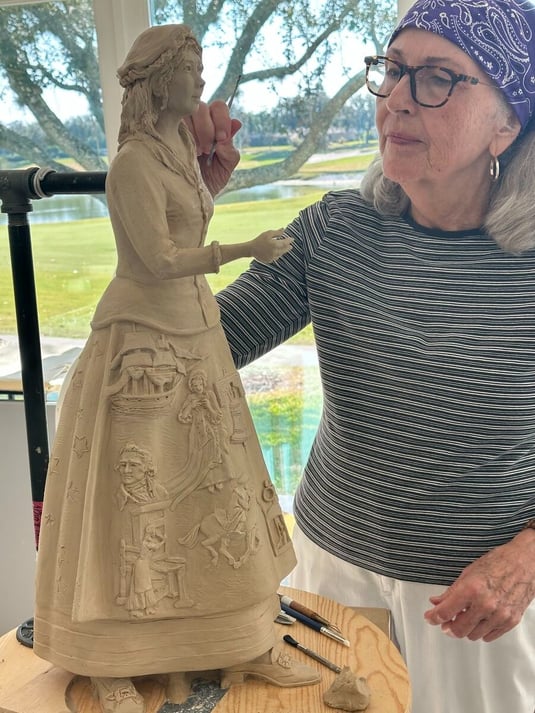
Becky Ault working on the clay model, refining the relief details in the skirt.
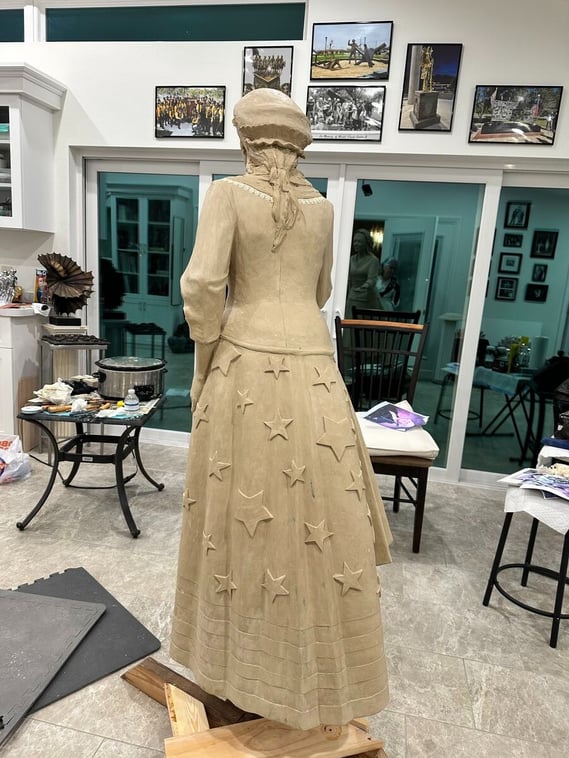
The full-scale clay model in the studio, before casting — the stars already worked into the skirt at this stage.
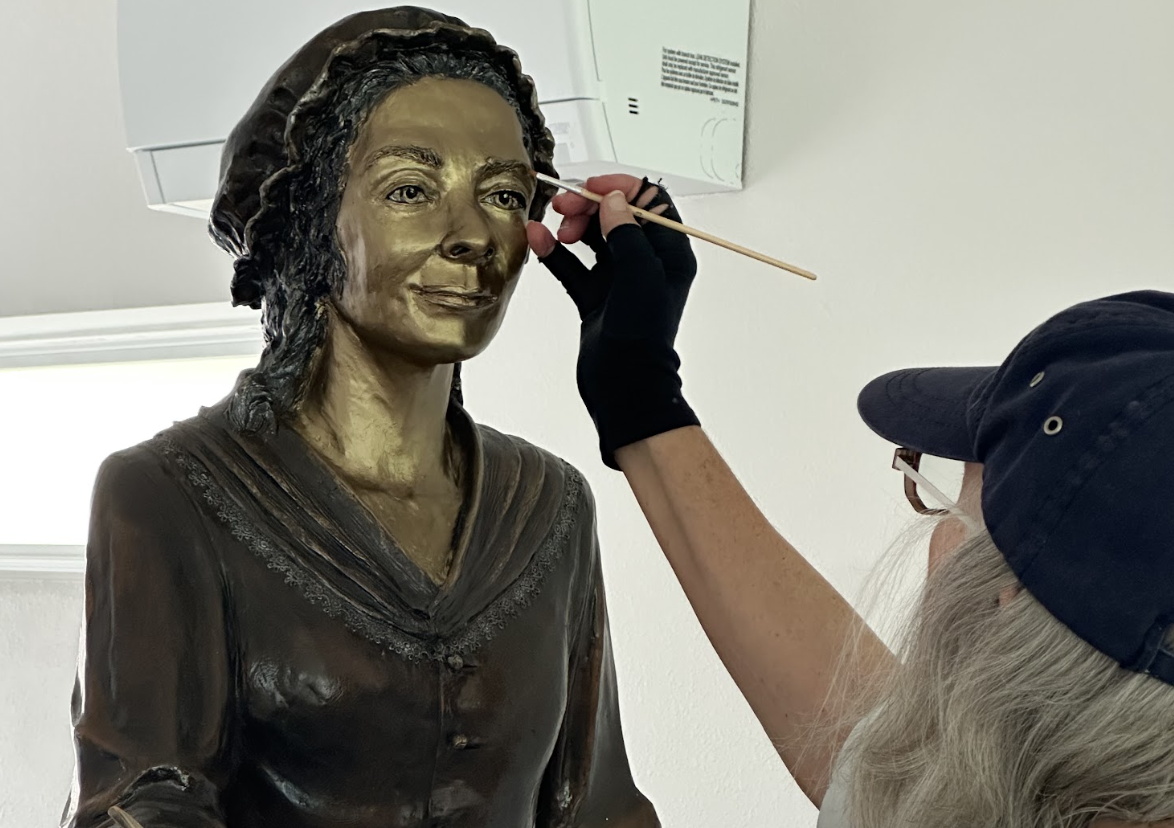
Once approved, the piece was sculpted full-scale in clay and cast in bronze using the lost-wax method: a rubber mold pulled from the clay, a wax pattern drawn from that mold, then ceramic shell molds filled with molten bronze. Once cooled, the raw castings were welded together, finished to match the original clay, and patinated.
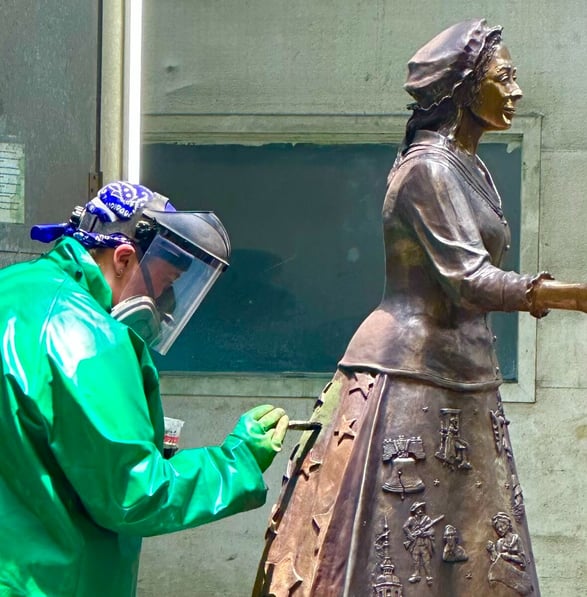
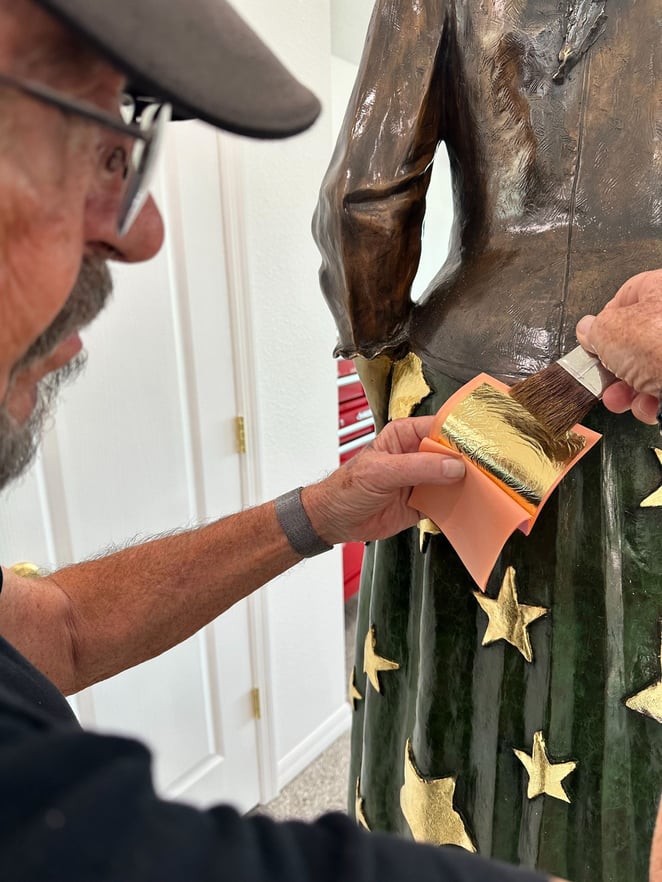
Gold-leaf Patina is hand-applied to the skirt, where raised imagery includes a bell, minutemen, and small architectural forms tied to the Revolutionary period.
As a final step, the stars and historical reliefs were gilded in 24k gold leaf. The process moved from paper to physical form, a printer's story translated into bronze.
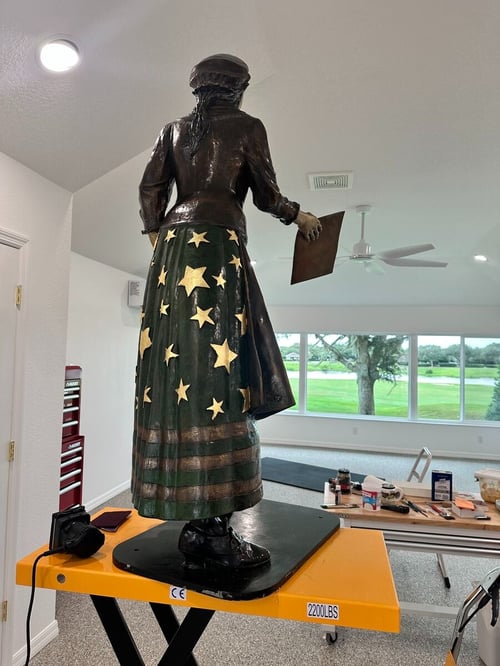
The finished skirt, patinated and gilded, with stars in 24k gold leaf set against the bronze.
“This project sits at the intersection of art, history, and community,” said Becky Ault. “It's about creating something that resonates across generations.”
A Place in Public Memory
The monument will be unveiled and dedicated at Veterans Memorial Park in Lakeland on Saturday, November 7 at 9:30 a.m., as part of the America 250 commemorations, and it's meant to serve as a gathering space too, for education and reflection, becoming part of Lakeland's landscape going forward.
The project's significance lies not only in restoring attention to a remarkable historical figure, but in what that act suggests about monuments today. Public art can preserve history while also reopening it, creating opportunities to discover people and stories that have long existed beyond the spotlight.
Goddard printed her name on a document that changed the country. Almost 250 years later, she is memorialized again, this time no longer a footnote, and cast in bronze.
Relevant posts