![codaworx-background-transparency (4).png]](https://knowledge.codaworx.com/hs-fs/hubfs/codaworx-background-transparency%20(4).png?height=40&name=codaworx-background-transparency%20(4).png)
Table of Contents
Getting Started
- Log in to your CODAworx Account
- Click your profile icon in the top right corner and select “CODAcommission Dashboard”
- Click “Post a New Call” in the upper right corner to open your project draft.
Project Overview Details
At any point, you can hit "Save and Continue" to save your progress. The form may stop you if you miss a required field.
The form defaults to Artist Call. If you want to hire an artist for a commission, you can leave this alone and begin filing out the project fields. If you’re looking for fabrication or manufacturing partners, click Industry Call before proceeding.
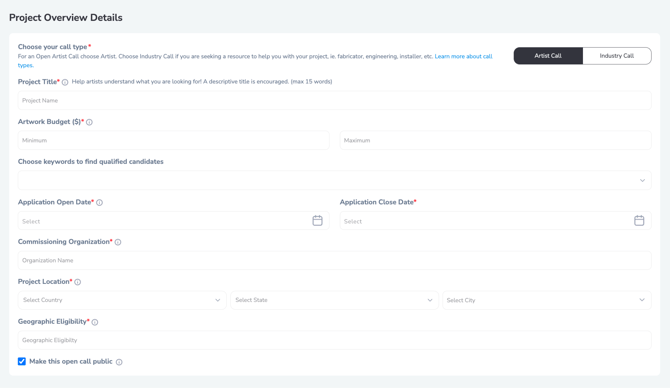
Project Title and Budget
- Project Title: Enter a clear, descriptive name for your project
- Artwork Budget: Both minimum and maximum budget amounts are required
- If your project does not have a strict minimum budget, enter $0 in the minimum field to proceed.
-
Keyword Tags
-
Keywords help match your project with relevant artists based on profile preferences. When you select a keyword, CODAworx surfaces your call to artists who have tagged their work with matching specialties, improving the quality and relevance of your applicant pool.
- Best Practice: Review the keyword dropdown carefully and select tags that are genuinely relevant to your project.
-
- Setting the Deadline: The calendar determines when your post expires. When you select your closing date, make sure you pick the day you would like your opportunity to expire. When you pick a date in the calendar, select ONE DAY AFTER the last day you want to receive applications. Your call will disappear from our open call listing page at Midnight GMT -5 (USA Central Time) on the deadline day you set.
- Commissioning Organization: Enter the name of the hosting organization
- Project Location: Enter the location in which this project will be installed
- Geographic Eligibility: Define whether your call is open to local, national, or international artists, along with any preferences that might be made during the decision process
- Public: Your open call is listed on CODAworx's Open Calls Directory and is discoverable by all artists on the platform. This is the recommended option for commissioners looking to reach the widest possible pool of qualified candidates
- Private: Your call is not listed publicly. Only artists who receive your direct application link can apply. This is useful when you already have a curated list of artists in mind, or when your project requires a closed, invitation-only selection process.
Project Brief
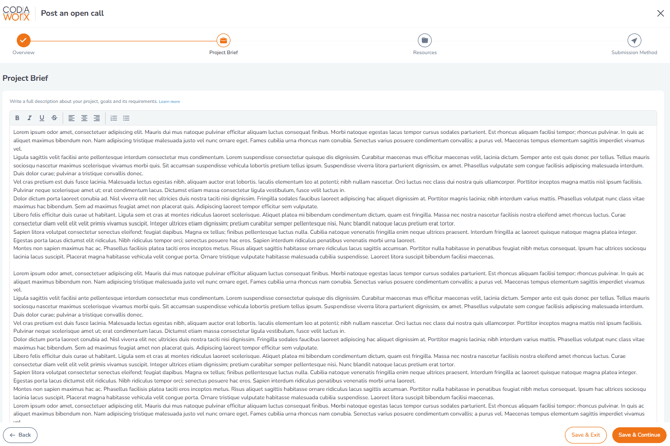
The Project Brief is your primary way to let artists know of details, timeline, layout, and aesthetic requirements of the project
- Character Limit: The brief has a strict maximum limit of 4,000 characters.
- Formatting Text: Use the built-in toolbar to apply styles (bold, italic, underline, strikethrough), adjust alignment, or create numbered and bulleted lists.
- Copying Text: You can copy and paste directly from Microsoft Word or Google Docs to preserve your text formatting. Images will also copy and paste.
- Note: Text copied directly from PDFs will lose its formatting. If your brief is in a PDF, please convert it to a Word document first before copying.
Resources and Documents
Use this section to attach formal Request for Qualifications (RFQs), site blueprints, videos and images, and other important information.
Commission Documents
- Format: Only PDF files, max file size 30 MB are accepted.
- To Upload: Click Upload. Ensure the checkbox next to the document is marked, then click Insert.
- Note: The document preview pane will only display the first page of your uploaded PDF.
- Commission URL: If you’d like to provide applicants with a link where they can learn more about your project, company, or relevant information, insert here.
Additional Documents & Images
- Follow the same upload steps to attach supplementary materials like site renderings, drone footage, or space dimensions.
- Add up to 6 high-quality images to give artists a clear understanding of what they will be working with, around, and for.
Submission Method
How you collect applications directly impacts the quality of your candidate pool and the efficiency of your review process. CODAworx offers two options depending on your needs.
Free Standard Application: The free tier gives you immediate access to post a call and begin receiving applications. It includes basic artist portfolio information, a resume, a letter of interest, and up to 3 work samples per applicant.
CODAworx Toolkit: The CODAworx Toolkit is designed for commissioners managing competitive, high-stakes selections.
|
Feature |
Free Standard Application |
Paid CODAworx Toolkit (Single Purchase or Membership) |
Why it Matters |
|
Work Samples |
Up to 3 work samples |
Up to 10 work samples, |
Jurors get a significantly deeper view of each artist’s range and past work, critical for large-scale projects. Most competitive public art commissioners expect at least 5 work samples. |
|
Custom Questions |
Not Available |
Fully Customizable |
Screen out applicants that don't meet your requirements before they apply by asking for specific qualifications from the beginning. Filter for specific experience, budget history, and/or project type to save time and effort. |
|
Jury Voting |
Not Available |
Round-based voting tools built into your dashboard |
Manage multi-round selection with a structured, documented process. No spreadsheets or long email threads needed. |
|
E-Blast ($500) |
Not Included |
Not Included |
Your call is promoted directly to CODAWorx’s artists, increasing visibility and application numbers |
Note: Your toolkit tier is locked once the first applicant submits. Review and upgrade your toolkit before publishing your call. If you're unsure which tier is right for your project, contact CODAworx Support.
When managing hundreds of applications, Commissioners using the CODAworx Toolkit consistently report higher-quality applicant pools and a more organized review process.
Learn more about our Toolkit: Membership Tiers Link
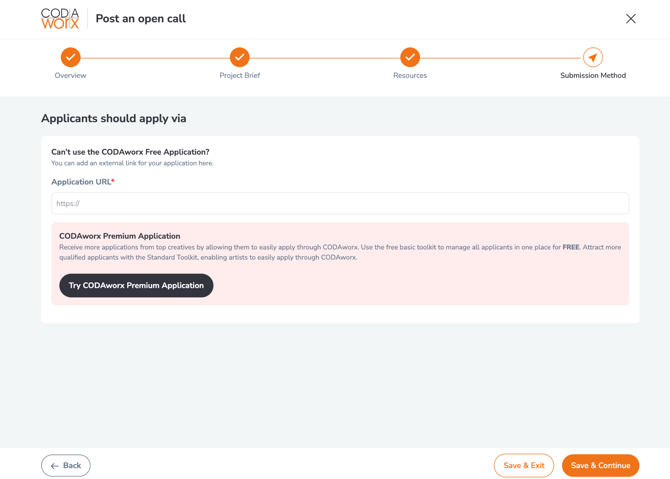
Adding a custom application link allows you to use your own software to handle applications. Applicants will be directed to your external link when viewing the open call.
Adding Samples of Work and Screening Questions
Jurors get a significantly deeper view of each artist’s range and past work, critical for large-scale projects with our toolkit. Most competitive public art commissioners expect at least 5 work samples. With CODAworx's free version, only 3 samples of work is allowed.
Screening questions help filter out candidates who may not fit the criteria and requirements for your call. Not only does this help commissioners save time when reviewing applications, but it also saves time for artists to apply for opportunities that align more to their areas of expertise. If you're looking for specific geographic locations, years of experience, cultural affiliation, etc., this is an opportunity to apply those screening questions.
Preview and Publish Your Call
When your call details are complete, you have three options at the bottom of the screen:

Preview
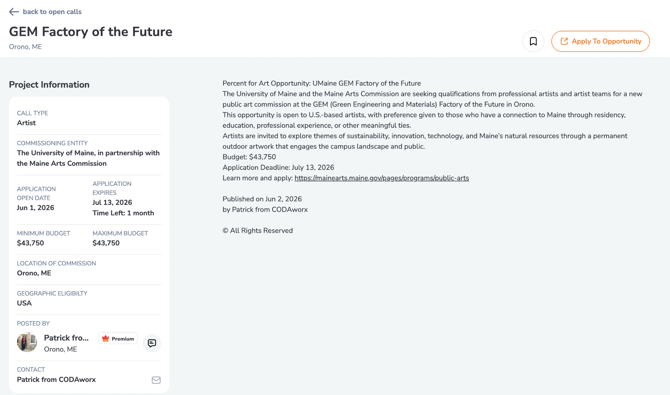
See exactly what your post will look like to potential applicants. The left sidebar provides information on deadline, budgets, and documents, while the main body displays your full project brief.
- To return to the form and make changes, click the three dots menu icon and select "Edit"
Save as Draft
Saves your current progress. You can safely leave the page and return to complete your posting via your CODAcommission Dashboard at any time.
Publish
Launch your open call live to the community based on your open date.
- NOTE: Review your submission settings and toolkit tier carefully before hitting publish. Once the first applicant submits to your call, the post is locked. You will no longer be able to change submittable fields from artists, like number of work samples or screening questions.
- If you choose publish, and today's date is before the open date you choose, the call will publish on your open date, and expire after your close date. If today's date is between the open and close date you choose, your call will publish immediately.
To access your published call, click on your profile icon in the upper right-hand corner. Then, select CODAcommission dashboard and select the title of the call you are trying to access.
Next Steps
Once your call is live, here's what comes next:
-
Monitor your applications: Visit your CODAcommission Dashboard to see incoming applications in real time.
-
Set up your jury: If you're using the CODAworx Toolkit, you can invite jury members directly from your dashboard to begin scoring applicants. See our Guide: Managing Your Jury
-
Review and select: Use CODAworx's built-in review tools to score, compare, and shortlist applicants across one or multiple rounds. Let your jury know how to vote
Need help? If you run into any issues at any point in the process, contact CODAworx Support
FAQs
How do I edit my call after applicants have already applied?
As long as no applicants have applied, you will be able to edit any any fields of the call. However, once applicants begin to submit their applications, certain fields will become edit locked, like the number of samples of work and custom questions.
Can I have more than one Administrator to call?
No, you cannot have more than one administrator. The individual who creates the call will have full access to editing, moving, and finalizing the call through its different phases. No one else will have access to that.
I am a government commissioner using a Purchase Order (PO). How do I handle payment?
We accommodate municipal and government workflows. If your organization requires a Purchase Order or an invoice layout to process payment for toolkits or listings, choose the "Invoice Me / Pay via PO" option at checkout or reach out to our billing department to sync our system with your procurement requirements.
Can I create voting rounds as applications come through? Can jury members vote even when I’m still accepting applications?
For best practice, CODAworx encourages commissioners to begin round-creation and jury voting when applications are no longer accepted.