The creative industries are changing fast, and the boundaries between artist, producer, and curator are increasingly fluid. Yet creative professionals are still expected to define their value using outdated, discipline-specific language. In a marketplace where adaptability is essential, perhaps it’s time to highlight a resilient ‘theory of practice’ instead of a list of old qualifications. That question was on my mind as I began rethinking my résumé as an annual ‘practice overview.’
When I’m asked to explain my role as a creative producer, I often feel as though I’m giving directions to a house at an unlisted address.
Most of our mental maps for creative industries are signposted by discipline-bound roles and material outcomes, which can make my work as a tradesman of interdisciplinary, conceptual frameworks a bit challenging to position. As the landscape of creative industries has shifted and the borders between artist, curator, and producer have blurred, sharing my CV has started to feel more and more like trying to articulate my value using some outmoded form of cartography. Then recently, I took my producing practice independent and suddenly it became imperative that I guide people with precision. I needed to choose a new kind of map.
A promising candidate emerged when a colleague asked if I had a “capabilities deck” to share. More commonly used by a marketing studio or design firm, it sits somewhere between a portfolio and a company narrative. It communicates value by tracing the line between skills and outputs, connecting a firm’s core competencies and their notable accomplishments. Intrigued, I started experimenting with a version that might be suitable for my solo practice. I dressed it up with the respectable essentials—case studies, relevant experience, publications—but it was still ultimately pinning my value to products over the principles that shape them.
But once I began tweaking the format to emphasize a theory behind my practice, I realized I may be on to something. I started by laying out my producing framework, illustrating how my capabilities work in concert at critical junctures in the creative process. It proposes that the nexus of my value is in the possession of an underlying “method to the madness” of creative production, a transposable logic distinct from the outcomes of that process. I then inverted the roadmap, beginning the deck by introducing “why” I’m called to produce and moving through the “how” of my framework before ultimately satisfying the reader’s curiosity about “what” I produce.
In this arrangement, it started to read like a manifesto. I titled it “Practice Overview,” tagging on next year’s date to incorporate a dimension of time. My CV could only ever reference achievements of the past, but here, I was announcing the latest evolution of a platform upon which my collaborations would derive their success in the year ahead.
Where I ultimately landed was as much a pragmatic pitch as it was a proof of concept. It confirmed to me that it is possible to key prospective collaborators into a different way of registering value. In the few weeks since sending it out, it’s returned job opportunities and invitations for project proposals. More importantly, sharing it has surfaced a surprising number of colleagues who are also looking for new ways to draw the arc of their practice.
To my fellow “unlisted” creative professionals, the invention here may be subtle, but perhaps it can spark just enough inspiration to begin laying new routes toward your unique position.
About the Author:
 Nicholas Medvescek is a US-based creative producer and transdisciplinary strategist known for his work at the intersection of art, technology, and cultural innovation. He has led initiatives and projects with organizations such as MIT Hacking Arts, A R E A Gallery, and the Harvard ArtLab, and co-created the Creative Producers Program for the Ars Electronica Festival, advancing research and practice in creative production. Medvescek’s work spans immersive experiences, interdisciplinary collaboration, and strategic creative facilitation, and he also teaches in the Business of Creative Enterprises program at Emerson College in Boston.
Do you have any thoughts on what creatives need to do to market themselves? Email editor@codaworx.com with thoughts. We'd love to hear your perspective!
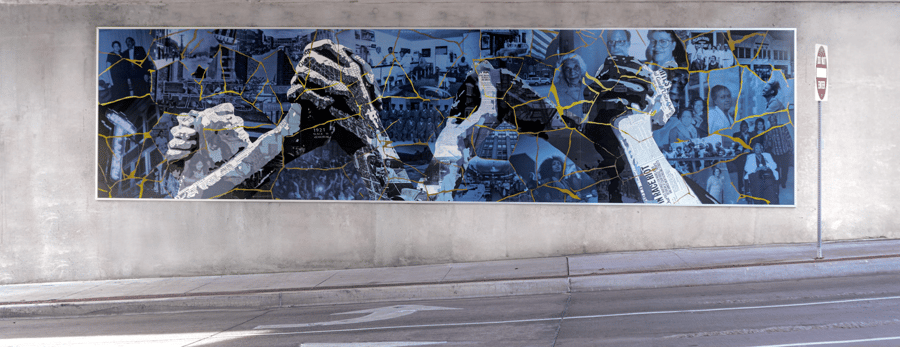
Lead Photo: Ritual / System by MASARY Studios, photography by Aram Boghosian