Header image: Crane delivery of a painted container by Hanna Barczyk for ROYALMOUNT. Client: Carbonleo. Led by MASSIVart.
- This article is a guest contribution from the placemaking and public art firm MASSIVart. -
Large-scale public art often looks effortless once it is installed. But behind the final work is a long sequence of decisions, from cultural strategy and artist selection to design development, fabrication, installation, and long-term maintenance.
In real estate, that process is shaped by a specific set of pressures. Public art has to carry meaning and artistic integrity, but it also has to respond to development timelines, construction constraints, municipal requirements, budgets, community expectations, and the long-term experience of a place.
This is why delivering public art in real estate is not only a creative exercise. It is a carefully coordinated process that begins long before an artist is commissioned and continues well beyond installation.
This article walks through that process to demystify what it takes to deliver large-scale public art successfully, and why getting it right matters for the identity, experience, and lasting value of a place.
Beyond symbolism: defining the role of public art
In traditional public space, art can exist primarily as a symbolic or cultural gesture. In real estate, it often has to operate within a broader development strategy.
That does not mean reducing art to a function. It means clarifying, early on, how it can contribute to the identity, experience, and cultural life of a place.
Successful public art integration begins with understanding place not only as a physical site, but as a social and cultural environment.
What role should the work play? Should it anchor a plaza, guide movement, create a gathering point, or integrate more quietly into the environment? Whose stories, histories, and perspectives are present, and whose are missing? How might the artwork contribute to a sense of belonging, continuity, or dialogue?
These questions shape scale, placement, the types of artists and practices that are appropriate, and how the work can resonate with the surrounding community and visitors.
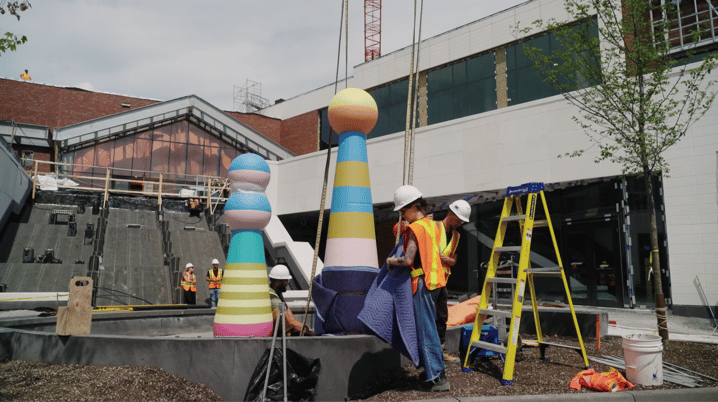 Outdoor integration of CHIAOZZA’s artwork at ROYALMOUNT, where durability, exposure, and site conditions informed every stage from design to installation. Client: Carbonleo. Led by MASSIVart.
At the same time, the site defines its own parameters. Structural capacity, exposure, circulation, budget, schedule, and municipal requirements all shape what is possible. The challenge is to ensure those parameters support the cultural intent rather than override it.
This early phase often takes the form of a cultural strategy. Depending on the scale of the project, from a neighbourhood-scale development to a smaller asset, that framework may be more or less complex, but its purpose remains the same: to define how culture, art, and community can be meaningfully integrated from the outset.
Grounded in placekeeping as much as placemaking, this process involves community members, creatives, and stakeholders connected to a place. It helps identify existing strengths, understand what may be at risk, engage diverse community perspectives, and map where cultural interventions can have the most impact.
When this groundwork is unclear, art is often treated as an add-on, fitted into spaces rather than considered as part of how those spaces are shaped. This can lead to misalignment later on, requiring revisions, slowing approvals, or limiting the work’s ability to connect meaningfully with its context.
Finding the right artistic fit
Artist selection is one of the most consequential moments in the process. The way the opportunity is framed at this stage shapes the quality of the proposals, the relevance of the artistic response, and how smoothly the project can move into design development.
The clarity of the brief, the level of detail around constraints, the available budget, and the selection process all influence how artists respond. When these elements are vague, proposals can feel disconnected from reality. When they are well defined, the conversation becomes more productive from the start.
Commissioning is not only about alignment. It is also about maintaining artistic integrity.
In development contexts, there is often a need to define narratives or project goals early on. While this direction is important, overly prescriptive frameworks can limit what makes artistic contributions distinct. The role of the artist is not simply to illustrate a concept, but to interpret place in ways that can expand or deepen it.
A strong commissioning process defines parameters without overdetermining outcomes. Whether through invited artists or open calls, clear criteria are essential to ensure alignment between creative intent and project realities.
A two-step approach is often used: an initial expression of interest, followed by a paid phase for a shortlist of artists to develop more detailed concepts. This supports stronger proposals while respecting the time and work involved.
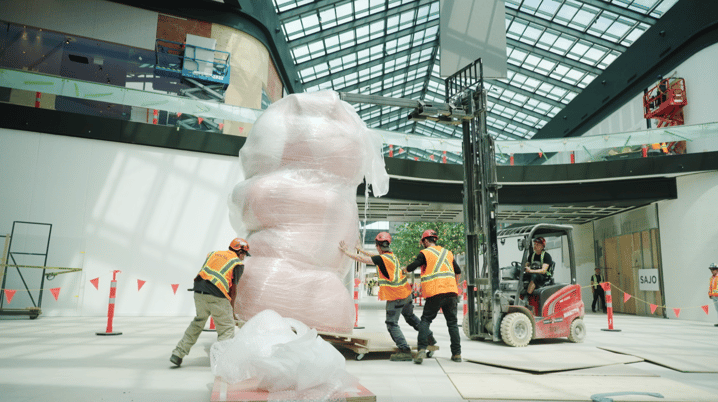 Delivery and positioning of Chun Hua Catherine Dong’s artwork for ROYALMOUNT, requiring coordination of access, equipment, protection, and sequencing. Client: Carbonleo. Led by MASSIVart.
Clarity upfront prevents friction later
One of the most underestimated aspects of public art delivery is identifying the roles, responsibilities, and governance required before a concept is even selected.
Who is responsible for structural anchoring? What infrastructure is required for lighting or power? Who covers site preparation? How will the work be maintained over time? How does it integrate within construction timelines?
These questions may seem operational, but they have a direct impact on the creative process. Addressing them early enables better design. Left unresolved, they tend to surface later, when flexibility is limited and costs increase.
The work evolves through coordination
Once a concept is selected, the project becomes a shared process.
An artwork must align with architecture, landscape, structure, lighting, access, and safety requirements. Each layer introduces its own constraints, and none of them operate in isolation.
This is where the work shifts. Materials are reconsidered, dimensions adjusted, and details refined. These changes are rarely dramatic, but they accumulate and shape the final outcome.
On large-scale real estate projects, it is not uncommon for artworks to be installed above underground levels, within strict load limitations, or in environments shaped by seismic, weather, access, or construction constraints. These factors directly influence how a piece can be designed, fabricated, transported, and assembled.
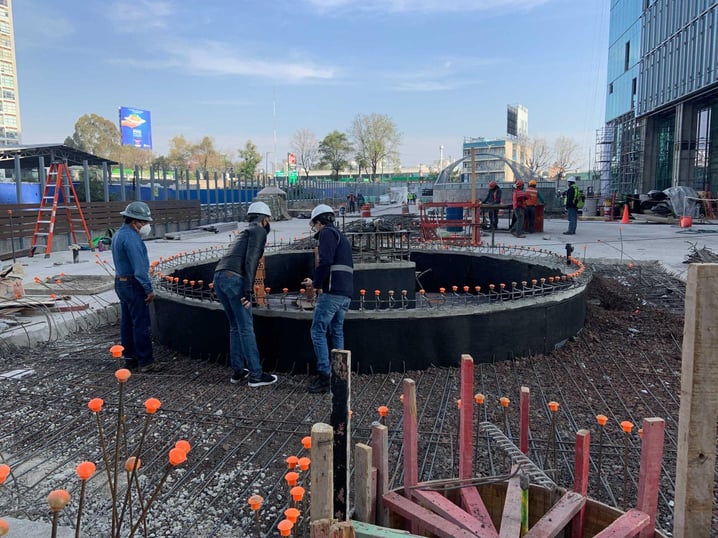 Structural coordination and site preparation for The Eye of Mexico by Ouchhh at Neuchâtel Cuadrante Polanco. Clients: MIRA and Ivanhoé Cambridge. Led by MASSIVart.
Situations like this are part of working in dense, complex environments. The difference lies in when constraints are addressed. Integrated early, they inform the design. Left for later, they tend to force compromises.
Timing shapes decisions
Public art in real estate projects has to align with construction, which brings its own pressures.
Fabrication, delivery, and installation are tied to site schedules that leave little room for delay. This often requires decisions to be made earlier than expected, with components developed and tested in advance, and logistics carefully planned before anything reaches the site.
The challenge is not only to complete the artwork, but to integrate it within a much larger process.
A collective process
While public art is often discussed in terms of authorship, its delivery depends on a broader network of contributors.
Fabricators, engineers, contractors, and project teams all play a role in translating an idea into something that can be built and maintained. Each step involves interpretation, and each decision leaves a trace in the final result.
What holds the project together is not a single vision, but the alignment of many.
What people experience is only the visible layer
Across different contexts, certain patterns remain consistent: clarity at the outset, a strong framework, realistic coordination, and enough flexibility to respond without losing direction.
Most importantly, successful projects recognize that public art is not only a cultural object. It is part of a broader system where each decision contributes to how a place is conceived, experienced, and sustained over time.
When approached through a place-led development lens, public art is not an addition to real estate. It is part of how places become meaningful.
That is what it really takes to deliver public art at scale: not only a strong artistic vision, but the strategy, structure, and coordination to carry it into the life of a place.
About this guest contribution:
MASSIVart is a global creative placemaking and public art strategy firm working at the intersection of culture, real estate, and place-led development. We help developers and property owners define the cultural and experiential strategy of their projects, shaping how places are positioned, experienced, and adopted over time. Working across public art, cultural infrastructure, programming, and placemaking, we build cohesive place ecosystems across multiple touchpoints, from landmark artworks and public realm interventions to amenities and community-facing experiences. From strategy to implementation, our work ensures each project is grounded in context, connected to its communities, and designed to create lasting identity, engagement, and value.

Website: www.massivart.com
IG: @massivart
LinkedIn: https://www.linkedin.com/company/massiv-art/
#MASSIVart