From a Visual Land Acknowledgment to Painted Cisterns
To enter the Madison Public Market, visitors pass through a land acknowledgment. Ho-Chunk graphic novelist Jim Terry's A Good Day covers the market's main doors and continues as a medallion in the entryway floor. It honors the market's location in Teejop (pronounced day-JOPE), the ancestral and current homeland of the Ho-Chunk Nation.
Terry's work is one of several commissions the Madison Arts Commission (MAC) has installed at the market, coordinated by the City's Cultural Resources Planner, Meri Rose Ekberg. Together, they offer commissioners a model for a civic building: put the most important statements at the thresholds, extend the program onto working infrastructure, and fund it with public and private money. "Each work brings the market to life, one piece at a time," Ekberg said in a statement released by the City of Madison.
At a Glance
|
Commissioner |
Madison Arts Commission, City of Madison |
|
Location |
Madison Public Market, Madison, Wisconsin |
|
Public funding |
Municipal Art and Percent for Art funds |
|
Private support |
Madison Community Foundation, Friends of the Madison Arts Commission, and Hoke Family Foundation |
|
Works profiled |
A Good Day; Wahuura Šgaac Nąąkšąną; four cistern murals; Greetings |
A Good Day by Jim Terry: A Visual Land Acknowledgment at the Entrance
Terry, a Ho-Chunk comic book artist whose memoir Come Home, Indio was a finalist for the LA Times Book Prize, arranged the work in four quadrants: a person paddling a canoe, marshland plants and water, cranes in flight, and deer in prairie grassland. At the center are the three sisters, corn, beans, and squash, a fitting image for the door of a food market. Native cattails, a Yellow-headed Blackbird, and a nod to the historic Mendota canoe discoveries tie the design to the site.
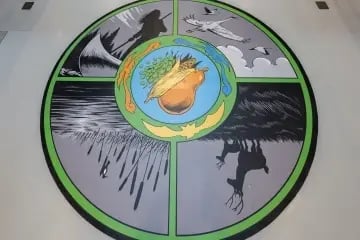
For commissioners, placement carries the meaning. A plaque can be walked past; a land acknowledgment built into the doors and floor becomes part of arriving.
Wahuura Šgaac Nąąkšąną by Nipinet Landsem and Caitlin Newago: A Privately Funded Exterior Mural
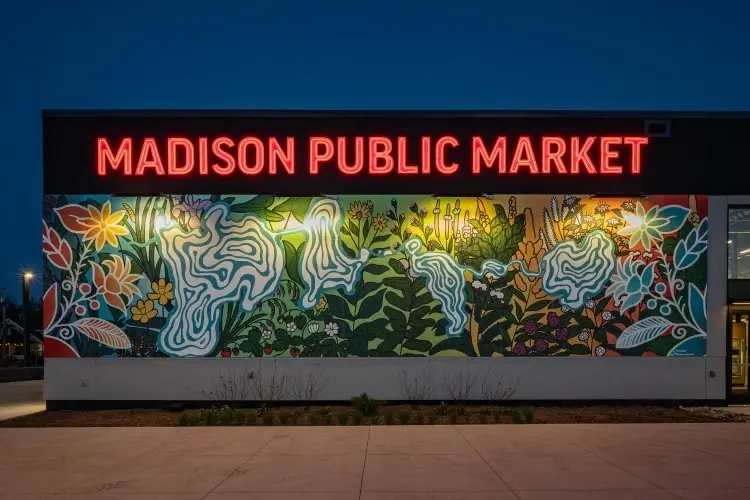
The Hoke Family Foundation sponsored the market's exterior mural through the Friends of the Madison Arts Commission. The design depicts the four lakes and the Yahara River, plant medicines from the area's wetlands and prairies, and an Ojibwe floral frame drawn from bandolier bag designs shared by the Ho-Chunk and the Ojibwe.
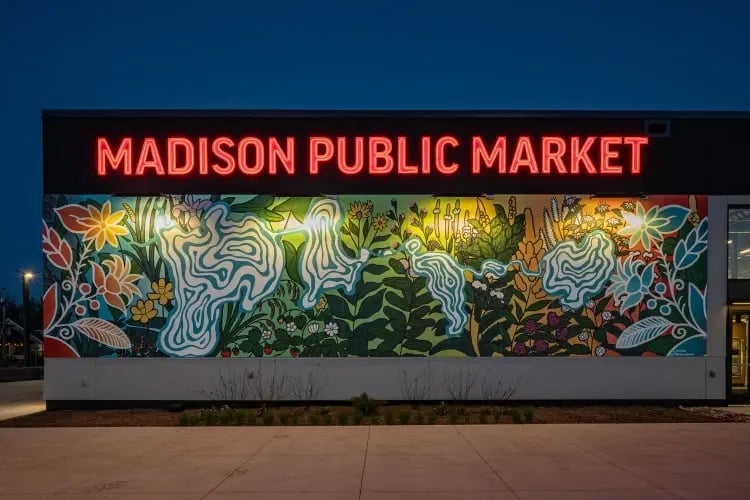
Landsem, a Minneapolis illustrator descended from the Turtle Mountain Band of Chippewa and a citizen of the Manitoba Métis Federation, and Newago, a muralist and tribal member of the Bad River Band of Lake Superior Chippewa Indians, met while living in Madison. "Teejop was a meeting place for many tribes, and so our process to create this design was deeply rooted in Indigenous community connections and knowledge," they said in their artist statement.
Four Cistern Murals by Mira Kim (Hello Madison): Infrastructure as a Canvas
[PHOTO: image 3, cistern murals]
Kim painted the market's rainwater cisterns with four regional animals: Cow: Dairyland Dream, Muskie: Depths of Mendota, Flamingo: Pink on the Hill, and Crane: Stillness in the Snow. She began Hello Madison in 2020 as an illustration project offering comfort during a difficult time. "My goal has always been to help bring more color, warmth, and connection to the city through art," Kim said.
Painting working equipment extends the program without adding new structures, an approach CODAzine explored in Art That Works: Infrastructure as a Canvas for Creativity.
Greetings by Actual Size Artworks: A Sculpture That Signals a Third Place
In the north entry alcove, a composite bear with antlers, horse hooves, and a cow's tail sits at a picnic table with a cup of coffee while a badger and duck creature eyes its food. The City describes the piece as marking entry into a "third place," somewhere between home and work to relax and socialize. Artists Gail Simpson and Aristotle Georgiades aimed for "an impression of delight tinged with oddness. This seems like a very Madison quality."
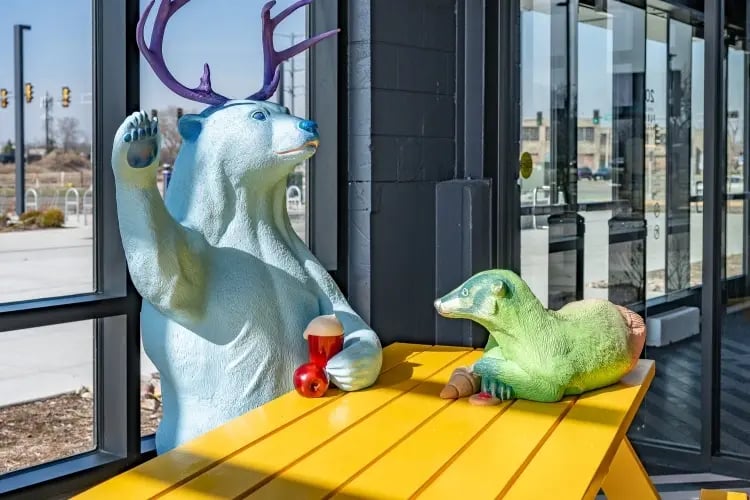
The lesson for commissioners: a brief can ask for a mood.
Lessons for Commissioners
- Use the thresholds. Doors, floors, and entries carry the statements every visitor should meet.
- Commission Indigenous artists to tell Indigenous stories. Both Indigenous works here come from Native artists working from community knowledge.
- Treat infrastructure as surface. Rainwater cisterns became a four-part mural series.
- Blend funding streams. Percent for Art and Municipal Art funds sit alongside foundation support. For more models, see Multiple Pathways to Funding Public Art and Bridging the Gap Between Vision and Budget in Large-Scale Public Art.
New civic buildings often open as blank space. The Madison Public Market's art gives it a history, a sense of humor, and a clear relationship to the land from the first day. For more on art that carries community values into public space, read Art for Social Change.
Commissioning art for a civic building? Have a project that needs art? Log in to CODAworx and post your open call in minutes. It’s free. → Post an Open Call
Artists and studios: upload your completed commissions so commissioners can find your work.
FAQ
What public art is at the Madison Public Market? The collection includes A Good Day by Jim Terry, the mural Wahuura Šgaac Nąąkšąną by Nipinet Landsem and Caitlin Newago, four cistern murals by Mira Kim, the sculpture Greetings by Actual Size Artworks, and several other exterior murals.
What is a visual land acknowledgment? It is an artwork that expresses what a written land acknowledgment states in words. At the Madison Public Market, Jim Terry's A Good Day honors that the market stands in Teejop, the ancestral and current homeland of the Ho-Chunk Nation.
How was the Madison Public Market's art funded? Through the City of Madison's Municipal Art and Percent for Art funds, with additional support from the Madison Community Foundation, the Friends of the Madison Arts Commission, and the Hoke Family Foundation.
Source: City of Madison, "Public Art Installations continue at Madison Public Market," April 20, 2026. Images courtesy of the City of Madison.