As we enter a new year full of promise and possibility, the oft-repeated question rises again: “What does the future hold for art in commercial real estate development?” With all the buzz about AI, new technology and augmented realities, it’s easy to get caught up in new trends and promises of “The Next Big Thing.” But, what if “The Next Big Thing” wasn’t something new, but rather a deeper exploration into what attracts us to art in the first place?
Art can play a surprisingly powerful role in commercial real estate (CRE). While the aesthetic advantages are apparent, its true power lies in how art influences financial performance and strategic positioning for a property. Thoughtfully integrated art influences how tenants – current and potential – perceive, use and value a property, which, in turn, shapes future marketing and leasing opportunities – aka, ROI!
Here are a few examples of the power of including artwork in commercial real estate in 2026 and beyond:
1. Placemaking and Integration:
All commercial real estate starts as a space, measured in square feet, rent, tenants and ROI. But people don’t form attachments to square footage alone. When integrated art is added to the equation, it forms a bridge from space to place. An application of meaningful artwork creates an emotional resonance in tenants and visitors, anchoring memories that form a visual identity for a property. Using art as a method of placemaking doubles down on this value, deepening the link between people and place by grounding a property in a local culture, history or identity that communities value and connect with.
The most successful art is often co-created with communities, not just for them. These projects are the result of engagement and collaboration, emphasizing local storytelling and reinforcing community identity. Encouraging local voices in the design process produces accessible artwork that encourages viewers to see their presence in the final product, sharing a sense of communal ownership and pride.
Collaborating with communities has been a critical part of my process from the start, and I have decades of experience leading engagement efforts.
My recent work on Presence of the Past and the Culture Crossing Pavilion was a deep dive into the value of rooting an artwork in the history and values of a community. Located along the banks of the San Pedro Creek, these twin artworks on the recently uncovered original foundation of the city’s St. James AME Church, pay tribute to the narratives and contributions of the previously enslaved African American community that played a pivotal role in San Antonio’s development. The design draws inspiration from the distinctive façade of the original Church as a testament to the lives, worship, and existence of those who once congregated there. This large-scale installation includes more than 300 names of original AME Church parishioners and features perforated metal designs inspired by Freedom Quilts and others developed through a continuing series of collaborative workshops engaging current parishioners, San Antonio’s youth and the general public to collect and preserve Church, community and family stories and history. These workshops, led by a partnership with Andrea Sanderson, San Antonio’s Poet Laureate, have been transformative experiences, weaving together aspirations for the future and reflections of the past. These motifs, names and worlds have harmoniously intertwined to form an intricate, cohesive reflection of the community, past and present, and has become one of my most memorable projects.
.jpg?width=922&height=518&name=Presence%20of%20the%20Past%20(1).jpg)
2. Stronger Recognition and Brand Identity:
Art strengthens recognition and brand identity in CRE by giving a property a distinct, emotional and repeatable presence in the minds of tenants, visitors and the broader community. Unlike a logo, sign or slogan, art makes connections at a human level, creating meaningful memories beyond just a single interaction. Here’s how it works: people remember images faster than names or slogans. In a sea of similar properties, art becomes a visual beacon that sets a property apart from the competition. The addition of an iconic artwork becomes a visual shorthand for the property – tenants reference the building by the art such as “The building with the big red sculpture.”
My Over the Moon was created for CityLine, a $1.5 billion mixed-use residential development in Richardson, an inner suburb of Dallas. The sculpture is rooted in the area’s rural heritage and chronicles the Texas’ evolution from ranches to urban landscapes. The iconic Texas longhorn, sitting on top of a crescent moon is a familiar and welcome symbol of the Lone Star State, and the moon’s curved profile resembles the letter “C” as in CityLine. In developing this concept, I wanted to emphasize the local identity and history of Richardson in a unique and innovative way. By incorporating playful elements from childhood memory, the sculpture embodies the true feel of CityLine – a live-work-play environment where active families and busy professionals gather and enjoy easy access to Dallas without living in the heart of a major city.
.jpg?width=1440&height=900&name=Over%20the%20Moon%20(1).jpg)
3. Elevates Perceived Quality and Credibility:
In addition to visual recognition, an investment in art elevates a property’s perceived quality and credibility. The addition of art, especially integrated installations or work created as part of a community-engaged design process, signals care and long-term investment, qualities that tenants, investors and partners associate with high-value properties. Unlike finishes and amenities – which can be changed out on a whim or during changes in ownership – art operates on a visual and psychological level, influencing how people perceive the property, often before they consciously realize it.
Artwork also reduces the perception of risk when it comes to investors and lenders. Though there is no “elixir” to reduce risk entirely, investors view artwork as a positive sign that a developer has invested in ways that mitigate the stressors that create financial and operational uncertainty. Property owners and developers that invest in artwork are likely to have also invested in features that attract and retain tenants, resulting in faster lease-up, higher renewal rates and reduced tenant turnover.
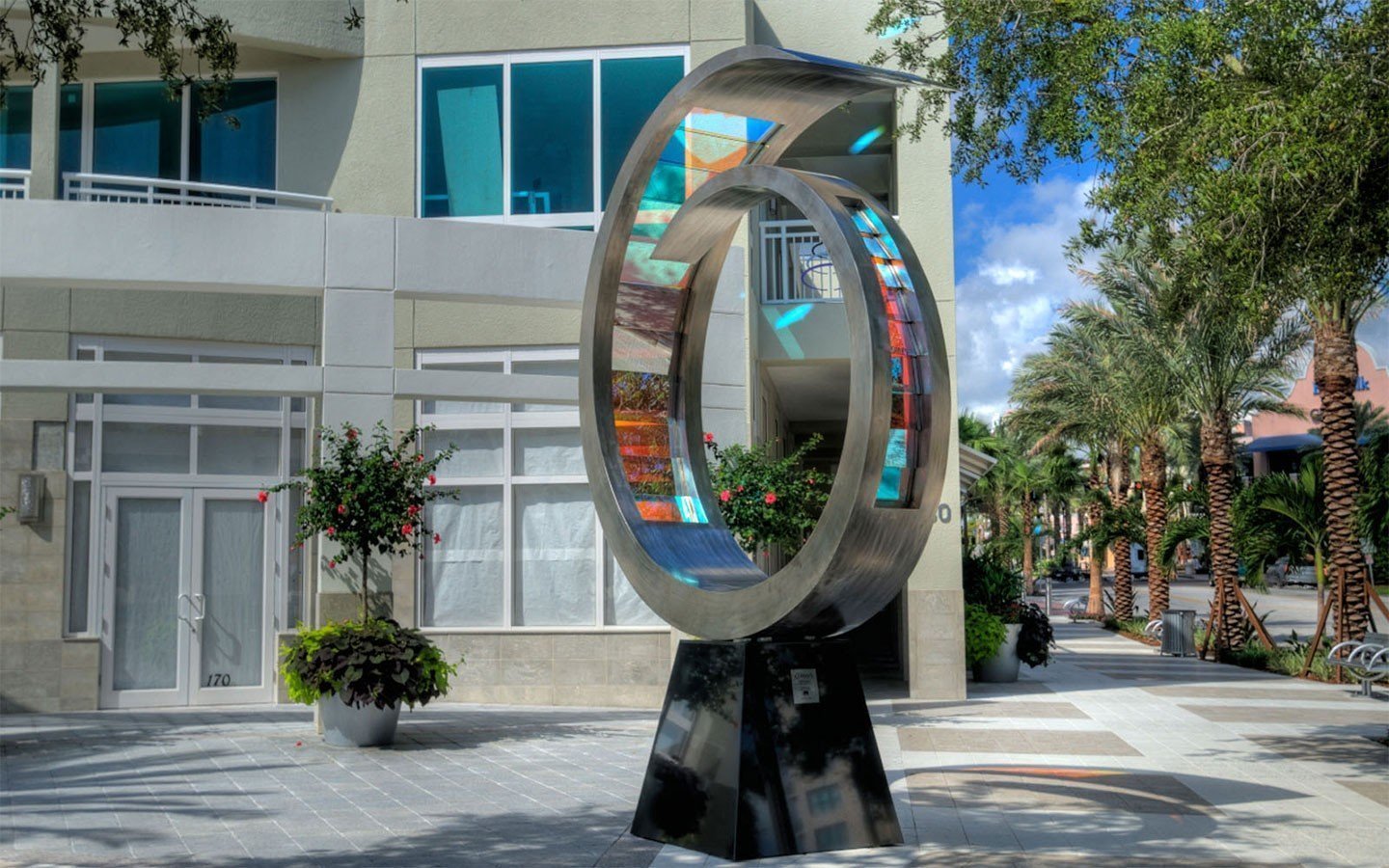
Developments such as Stanford Research Park in Palo Alto and the downtown luxury waterfront community in St. Petersburg have embraced significant artwork on their properties with the interest of engaging pedestrians and motorists arriving to the campus’ or driving by. For Stanford Research Park, the first goal was to create an installation that was fully integrated into a relatively complex landscape plan. Through its multi-layered and angled wedge shape, Aperture appears to emerge organically from the landscape. For downtown St. Petersburg’s luxury waterfront community, O Wave was meant to symbolize Florida’s Gulf Coast, with its circular shape and ocean-inspired hues. Its striking colors and angles enhance the environment evoking a sense of movement and inviting viewers to experience shifting light, vibrant colors, and a moment of reflection shaped by changing perspective.
As we look to the future of commercial real estate, the most lasting value of art lies not in trends and new technologies, but in its ability to connect people and places. Thoughtfully integrated artwork transforms properties into experiences: shaping perceptions, strengthening brand identity, fostering community and enhancing perceived quality. From placemaking projects that honor local history to iconic installations that create emotional and visual landmarks, art serves as both a strategic and human-centered investment.
If you’re looking to invest in artwork to enhance the value of your property, we’re here to help! Visit Gordon Huether Studio or contact us at mail@gordonhuether.com and (707) 255-5954.
Do you have news, stories, or projects to share? We’d love to hear from you—reach out to editor@codaworx.com.